
Smart Ass Take:
In another great newsletter, my friend Curt Buermeyer summarizes Peter Diamandis’s three-phase roadmap from AI labor disruption to post-scarcity abundance. I’ll be honest — I want to believe it. Curt and I agree that the next five years are going to be rough. But where he sees a ten-year arc bending toward something beautiful, I see a timeline that assumes robotic construction, autonomous transport, AI healthcare, and vertical farming all scale and democratize faster than any infrastructure transformation in human history. But here’s the thing about being a pessimist: often you’re wrong, and that is a beautiful thing. Curt’s optimism is grounded and honest, not naive, and Diamandis has a track record of being right about exponential curves before the rest of us could see them. So I’m bookmarking this roadmap not because I’m convinced, but because I hope like hell they’re right and I’m wrong.
Article Excerpt:
I believe we’re facing a reality where roughly 40% to 50% of white-collar jobs—the knowledge work that college students and recent grads have spent years studying for—will likely be displaced almost overnight.
Article Summary:
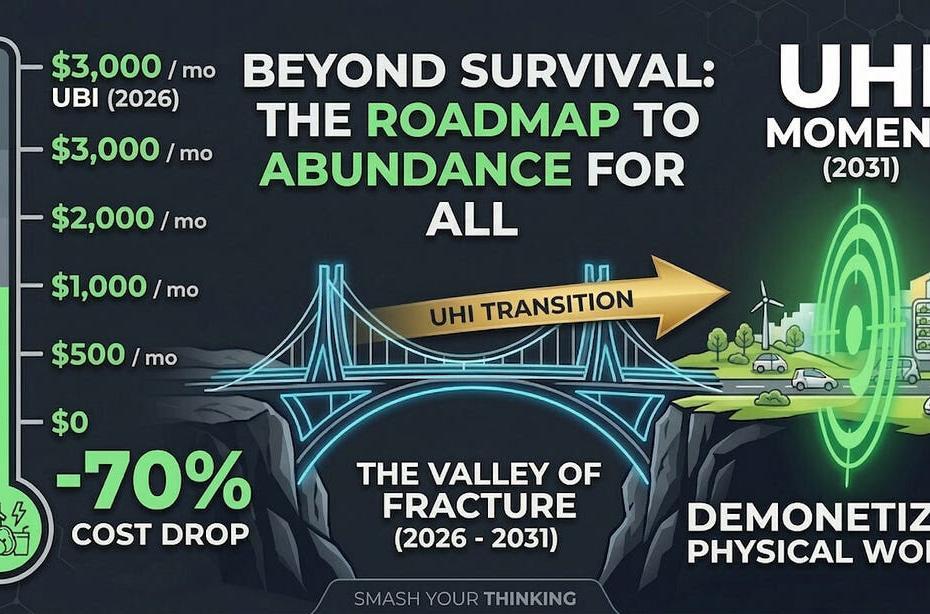
Curt Buermeyer’s latest Smash Your Thinking newsletter summarizes a roadmap by Peter Diamandis (XPRIZE founder, exponential tech evangelist) for navigating the AI-driven collapse of the labor market without also collapsing the social contract. The core argument: the AI disruption won’t look like the Industrial Revolution, which reshuffled the workforce over 150 years. This one is compressed into a decade, and there’s no adjacent sector to retrain into because AI is eating every sector simultaneously.
Diamandis lays out three phases. Phase 1 (2025–2028): the fracture. Jobs disappear, identities crater, and the proposed floor is a $3,000/month Universal Basic Income paired with a 32-hour workweek to keep people attached to purpose and social structure while the shock absorbs. Phase 2 (2028–2031): the automation dividend. AI companies have extracted enormous value from public infrastructure — our data, our research, our systems — and the public deserves a share. Think Alaska Permanent Fund, but for the robot economy. Phase 3 (2031–2035): the great deflation. Housing drops from $2,000/month to $600. Transport falls to $225. Food, energy, and healthcare trend toward near-zero marginal cost, driven by robotics, solar, autonomous fleets, and AI diagnostics.
Curt adds his own caveat: he’s skeptical the Phase 3 deflation happens as fast as Diamandis projects. Prices in housing, healthcare, and food have never actually gone down for normal people, and he’d bet the timeline slips. The actionable close is straightforward: share the roadmap, audit what you’d do with your time if survival wasn’t the point, and pressure policymakers to build the bridging mechanisms now — before “the Valley” between 2026 and 2031 turns into something uglier.
Read the Full Article
Get the best of Sevenelles in your inbox. Free, no ads, one click to leave.
Subscribe