My Two Cents:
We are so fucked. We are so totally fucked.
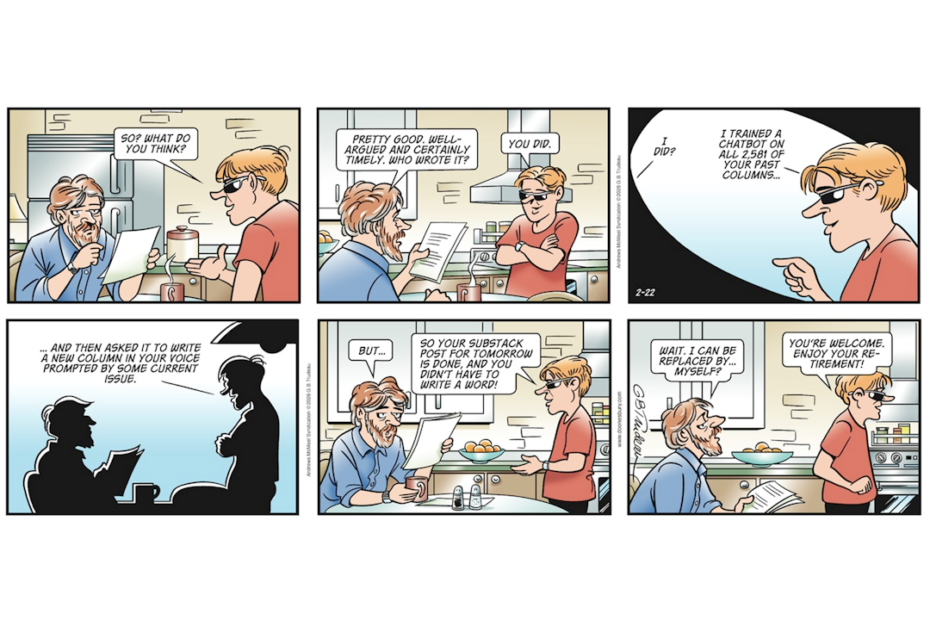
Usually, I follow that statement with, “but there is always hope.” Josh Tyrangiel’s article in The Atlantic leaves little room for hope, given the dysfunctional state of our democracy.
Here’s one of the many quotes from the article that paints a dire picture of AI’s impact on America’s working class:
“But I’m telling you it’s the end of America as we know it if we don’t use this moment to do things differently.”
Gina Raimondo
(former Rhode Island governor,
former US Commerce Secretary,
current venture-capital executive)
If you are fortunate enough to be in or nearing retirement with adequate savings to survive a major financial nut-punch, you can skip the article. For everyone else, read the article and plan ways to protect the family jewels.
Article Summary:
In 1869, Massachusetts created America’s first Bureau of Statistics of Labor to measure workplace conditions during the Industrial Revolution, establishing the principle that democratic governments should track what’s happening to their workers. Today, as artificial intelligence threatens to sodomize the American Dream, that commitment to measurement and evidence-based policymaking is being sorely tested.
While economists see no clear data yet showing AI’s impact on employment, corporate leaders are openly warning of massive job losses. CEOs from Ford, Anthropic, and other major companies have predicted that AI could eliminate 10-20% of jobs within years, with some estimating that half of white-collar positions could disappear within a decade. The scary part: after openly discussing these projections just a few months ago, executives have gone silent, advised by PR teams to stop talking publicly about AI and layoffs.
Economists remain divided on timing and severity. Some, like Federal Reserve Bank of Chicago President Austan Goolsbee, argue it’s too early to draw conclusions—productivity is strong and unemployment remains low. Others, like MIT’s David Autor and Daron Acemoglu, emphasize that speed matters: gradual change allows societies to adapt, but rapid disruption causes lasting damage, as seen with the “China shock” that devastated US manufacturing communities in the 1990s.
However, economist Anton Korinek warns this time may be different. Unlike previous technologies, AI can help deploy itself, potentially compressing decades of change into years. If 40% of global jobs are affected rapidly, as the IMF projects, our already hideously dysfunctional political institutions may not have the cajones to save the working class.
Our feckless Congress is paralyzed by fear of an authoritarian buffon, unable to even fund expanded labor statistics or revive worker retraining programs. In a classic “fox guarding the henhouse” move, the Trump administration has delegated AI oversight to venture capitalist David Sacks, who has hundreds of AI investments. Without political action, the challenge may ultimately be less about jobs than about whether our republic survives AI.
Article Excerpt:
“Mass job loss doesn’t just mean unemployment; it means missed loan payments, cascading defaults, shrinking consumer demand, and the kind of self-reinforcing downturn that can transform a shock into a crisis, and a crisis into the decline of an empire.“