
Smart Ass Take:
I am fully aware of the irony. You are about to read a 250-word summary of an article whose final paragraph scolds you for skimming it. This is the literary equivalent of handing out pamphlets on the dangers of pamphlets. Still, the piece landed a punch I wasn’t braced for. The problem isn’t that we stopped reading. It’s that we read the way a raccoon goes through a dumpster: fast, zigzagging, grabbing whatever’s shiny, leaving a mess. I read all day. Emails, headlines, the comments under a video of a goat on a trampoline. Almost none of it gets past my eyeballs. The part that stuck (I read it twice, so give me partial credit) is that the goal is time spent, not pages finished. That’s LEARN, obviously. It’s also LIVE, because an hour your brain spends outside the algorithmic meat grinder is an hour you actually got to keep. I’m not giving up my phone. I’m also no longer pretending the phone is on my side.
Article Excerpt:
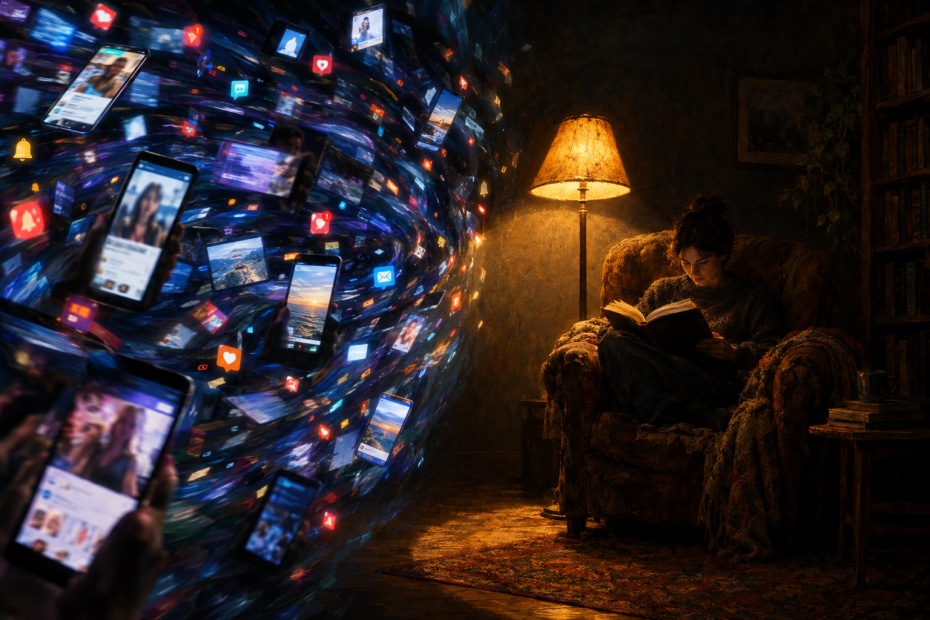
“This spin through the algorithmic meat grinder often leaves us feeling mentally exhausted.“
Article Summary:
Reading in 2026 is a contradiction. Comprehension scores keep sliding, many college students can’t finish a whole book, and most Americans read five or fewer books last year. Meanwhile, Gen Z has rediscovered books as both hobby and accessory, complete with reading parties and celebrity book clubs. Eve Upton-Clark argues the real question isn’t how much we read, but how deeply.
The enemy is brain rot. Sixty-three percent of U.S. adults aged 18 to 29 say they’re online almost constantly, and a 2025 study linked junk content to emotional numbness, cognitive overload, and feeling worse about yourself. Deep reading is the opposite: slowing down, thinking critically, stepping into a character’s shoes. Research ties it to resisting misinformation and easing stress and loneliness.
JT Torres, an educational psychologist at Washington and Lee, says the actual literacy crisis isn’t whether people read. It’s that nobody is teaching them to read critically, a problem AI dependence is making worse. Fiction in particular correlates with understanding other people, which is roughly the reverse of what your feed is doing to you.
The fix is a workout plan, not a reading list. Set goals by time, not book count: an hour, whether that gets you five pages or fifty, and any book counts (even romantasy if needs must). Pause on dense passages, imagine yourself in the plot, and those habits bleed into how you treat that suspicious Facebook post. The article closes by telling skimmers to go back to the top. Fair.
Read the Full Article
🌱 Try This
This week, run the article’s experiment on yourself: one hour of reading measured by the clock, not the page count.
- Pick any book you actually want to read, trashy or classic, it doesn’t matter.
- Put your phone in another room and set a kitchen timer for sixty minutes.
- Every time a passage makes you pause, stop and ask what it means or what you’d do in that character’s place before moving on.
- When the timer goes off, notice how many pages you got through and refuse to care.
Get the best of Sevenelles in your inbox. Free, no ads, one click to leave.
Subscribe