
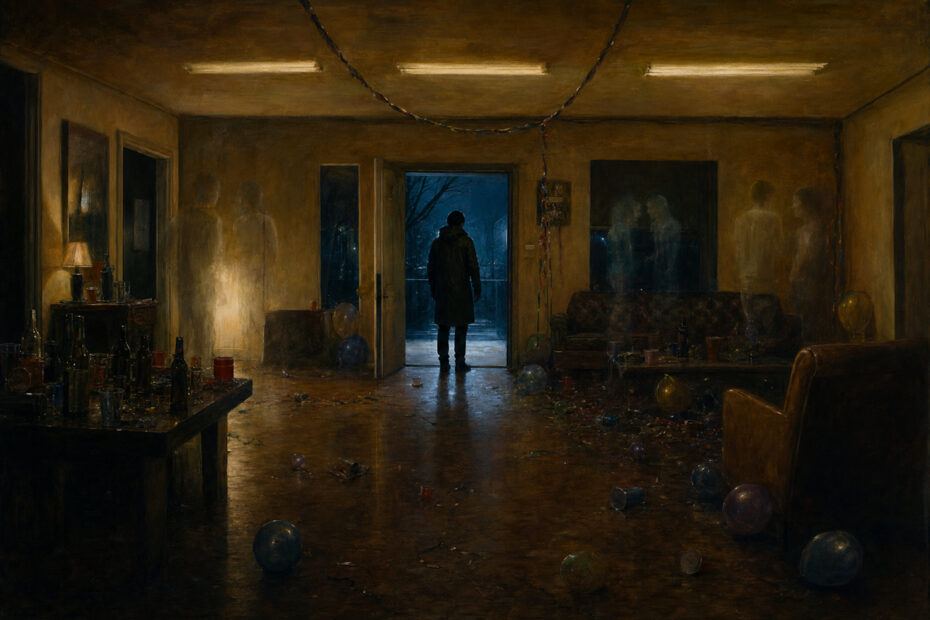
You know the moment. The party’s over. Everyone knows the party’s over. The playlist died two songs ago and someone turned on the overhead lights, which is the equivalent of a war crime against ambiance. But nobody’s actually left. You’re standing in the host’s doorway with your coat on, saying “okay, well…” for the ninth time, performing a goodbye that has somehow become longer than the event itself.
That’s social media right now. The whole thing. All of it.
A deeply thorough piece from Ars Technica this week serves as the most honest eulogy I’ve read for a thing that isn’t quite dead yet. which, if you think about it, is the perfect condition for a eulogy. Nobody writes a good one after the grief has settled.
Researcher Petter Törnberg from the University of Amsterdam has been studying the structural mechanics of social media. His findings are roughly: echo chambers aren’t a bug, they’re load-bearing walls. The toxicity isn’t caused by algorithms or human nature alone — it’s architecturally embedded. You can’t renovate your way out of it. You’d have to demolish and rebuild.
So here we are. Lingering in the doorway.
The Room Is Full of People Who Aren’t Really Here
What fascinates me is the texture of this moment. Not what’s happening commercially, but what it feels like to be a person inside it.
Because the few people I know who have not already left have one foot out the door. They’re still scrolling, still posting, still checking notifications with the compulsive regularity of someone touching a zit to see if it healed yet.
Törnberg’s data backs this up with uncomfortable specificity. Posting on Facebook, YouTube, and Twitter/X has declined sharply among actual humans. But the platforms don’t look empty because the bots moved in. “We don’t need the users anymore,” is apparently the quiet logic now. The platforms can simulate the bustle of a thriving public square, while the actual public has wandered off to AI conversations and rediscovered humans in real life.
Let that sink in for a second. You’re performing for an audience that is increasingly composed of things that are not people.
So Where Do We Go From Here?
Törnberg identifies three emerging replacements for the thing we used to call social media: private group chats (WhatsApp, Discord), algorithmically curated broadcasting platforms (TikTok, Reels), and people just straight-up talking to AI chatbots instead of each other. He notes — with what I imagine is the measured tone of a man trying not to scream — that roughly twice as many people are now talking to a chatbot as are posting on social media.
Twice as many.
We replaced the illusion of connection with something that doesn’t even pretend to be a person who give two fucks. And somehow that feels more honest, which is either progress or the most depressing thing I’ve written today.
The Long Irish Goodbye of Western Civilization
Here’s what I find genuinely strange about this particular threshold: we’re not grieving. Not really. If anything, most people seem relieved, in the same way you feel relieved when a relationship that’s been dying for two years finally, mercifully ends. You’re sad, sure. But mostly you’re just tired. And maybe a little embarrassed about how long you stayed.
The party metaphor keeps working because parties have a social physics of their own. There’s a tipping point where enough people leave that the remaining guests suddenly feel self-conscious about still being there.
Social media hit that tipping point a while back. The people still posting with full sincerity — the ones who still believe the room is real and the audience cares — increasingly look like they’re performing karaoke to an emptying bar.
Törnberg’s most unsettling finding, to me, is about what happens when the casual users leave and only the most partisan, most extreme voices remain. It’s the boiling-the-frog effect. The temperature rises so slowly that the people who stay don’t notice they’re being radicalized by the very act of staying.
Sound familiar?
What Comes Next Isn’t a Better Party
The tempting narrative is that we’ll find something better. Smaller, kinder, more human-scaled (I’m looking at you, BlueSky). A digital coffeehouse. A virtual pub where everybody knows your name, the conversation is civil, and the beer is metaphorical but ever so fucking satisfying.
Törnberg pours cold water on this. Private groups aren’t constrained by geography the way a real coffeehouse is. A WhatsApp group can tip into an echo chamber just as fast as a subreddit — faster, maybe, because there’s no public scrutiny.
So we can’t stay at the party. We can’t go home alone. And the next party might be worse.
Cool. Great. Love it here.
I keep coming back to this: it’s always been and remains performative. And now the performance is standing in the doorway with your coat on, saying “well, we should do this again sometime,” knowing you won’t, knowing they know you won’t, and doing the bit anyway because the alternative — just turning around and walking into the dark without a script — is terrifying in a way that small talk never is.
Social media trained us to perform the ideal version of ourselves. Now the stage is collapsing, but we’re still hitting our marks and running our lines.
The only honest thing left to do is put your coat on, step outside, and figure out who you are when nobody’s watching.
Which, of course, is the one thing the last fifteen years made sure we never learned how to do.
Read the Ars Technica Article
Get the best of Sevenelles in your inbox. Free, no ads, one click to leave.
Subscribe