
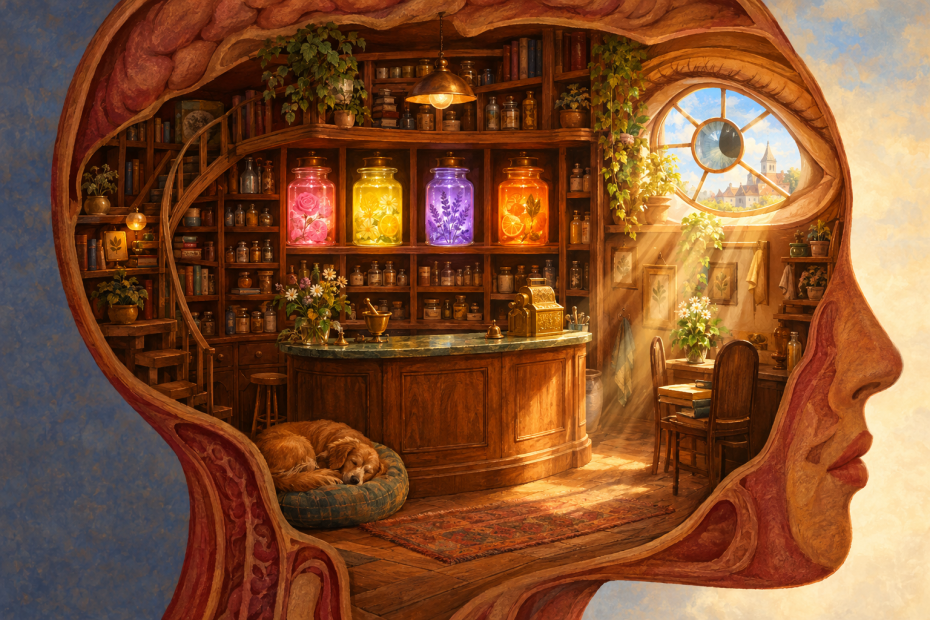
Your brain runs a pharmacy. It’s understaffed, keeps strange hours, and some mornings the pharmacist just doesn’t show up. You stand at the counter holding your little ticket, and your brain pays you no mind.
I’ve stood at that counter, depressed and anxious, wishing I could coax my mind into a better state. So have you, probably, even if you’d rather not admit it. All of us quietly struggle with something sometimes: anxiety that hums under everything, a low-grade gray that won’t lift, a motivation tank that reads empty by 10 a.m. We pretend we’re fine because everybody else seems fine. But here’s the thing: everybody else is also pretending.
So let’s skip the pretending and talk about the pharmacy itself. Your brain’s pharmacy serves up four chemicals that do the heavy lifting when it comes to feeling good: oxytocin, serotonin, dopamine, and endorphins. These are often referred to as your “Feel-Good Hormones”. The good news is: you can nudge your pharmacy to dispense them through some small, easy actions or habits.
(Obligatory honesty: none of these recommended actions or habits replace therapy or medication. If your brain needs actual pharmaceuticals, taking them isn’t failing. It’s wise self-care. These recommendations are supplements to care, not substitutes for it.)
Oxytocin: The Hug Hormone (No Childbirth Required)
What it is: Oxytocin is a hormone and neurotransmitter, famous for its starring role in childbirth and breastfeeding. Where it comes from: It’s made in the hypothalamus and released into the bloodstream by the pituitary gland. What it does to you: It triggers feelings of bonding, trust, belonging, and that warm “these are my people” feeling. It also takes some of the edge off stress.
The good news for those of us who are not currently giving birth or on a promising third date: oxytocin is surprisingly easy to coax out.
- Hug someone, and mean it. A long one. Not the two-pat church hug.
- Get a haircut or a massage. Friendly professional touch counts, and a fresh haircut does things for the ego no affirmation ever has.
- Make real eye contact. Prolonged eye contact can do some of what touch does. Ease into it, or you’ll be that guy with the unwavering stare of a stalker.
- Stare at your dog. A 2015 study found that when dogs and owners gaze at each other, both get an oxytocin bump. Your dog has been trying to tell you this for years.
- Compliment a stranger. A genuine one. “Great jacket” counts. “You look less tired than usual” does not.
- Write an unsent letter to someone you love, or jot a line of gratitude in a journal. Yes, it’s cheesy. Cheese is load-bearing here.
- Hug yourself. If all else fails. Nobody’s watching. Probably.
Serotonin: The Mood Stabilizer With a Complicated Reputation
What it is: Serotonin is a neurotransmitter tied to mood, sleep, memory, digestion, and libido. Where it comes from: Here’s the weird part: most of your body’s serotonin is made in your gut. Your brain makes its own supply separately, in a cluster of cells in the brainstem called the raphe nuclei. What it does to you: It steadies you. Calmer, more even, less likely to cry at a car commercial (no promises).
You’ve probably heard depression is “low serotonin.” A 2022 review found no consistent evidence that low serotonin actually causes depression, which is science politely saying “it’s more complicated than the pamphlet.” Serotonin still matters plenty for mood and sleep, though. Ways to help it along:
- Get bright, natural light in the first hour of your day. Coffee on the porch counts. Coffee in a dark kitchen while reading bad news does not.
- Smell something tied to a happy memory. Cinnamon, your grandmother’s soap, fresh-cut grass. Scent has a shortcut to the emotional memory centers.
- Do something kind for a stranger with zero expectation of credit. Paying for the coffee behind you is a classic for a reason.
- Hum, sing, or breathe slowly on purpose. These stimulate the vagus nerve, which appears to play a role in serotonin signaling. Your shower acoustics are finally useful.
- Turn down the stress. Cortisol gets in serotonin’s way. Yoga, meditation, or ten minutes of not doing anything all help.
Dopamine: The Slot Machine in Your Skull
What it is: Dopamine is the neurotransmitter of reward, motivation, and wanting. Where it comes from: Mostly two small regions in the midbrain, the ventral tegmental area and the substantia nigra. What it does to you: It makes you want things, chase things, and feel a little sparkle when you get them.
Dopamine isn’t picky. It shows up for finishing a project and for gambling, for a good workout and for a third doughnut. It’s also why your phone feels like a tiny casino you carry in your pocket. Every notification is a pull of the lever. Healthier ways to trigger it:
- Collect “micro-completions.” Send the text. Clean one shelf. Cross something off a list, even if you wrote it on the list after doing it. (We all do that.)
- Add a little novelty. Take a new route home, try a different coffee, or just move to another room to reset your focus.
- Plan something you’re looking forward to. Dopamine loves anticipation almost as much as the reward itself. Planning the trip is half the trip.
- End your shower with 30 seconds of cold water. One study found cold-water immersion boosted dopamine dramatically. That study involved an hour in 57-degree water, so the 30 seconds is the coward’s version. I am that coward.
- Spend an hour without your phone, ideally outdoors, or doing one single thing at a time.
- Try Non-Sleep Deep Rest, a guided relaxation and breathwork practice. A small study of experienced practitioners found a notable dopamine release during a session. (The study had eight people, so call it promising rather than proven.)
Endorphins: Your Body’s In-House Painkillers
What they are: Endorphins are a family of the body’s natural opioids. Where they come from: Mainly the pituitary gland and hypothalamus. What they do to you: Dull pain, ease stress, and deliver that loose, glowing, “why was I so worried?” feeling after a hard effort.
As Elle Woods put it in Legally Blonde: “Exercise gives you endorphins. Endorphins make you happy.” A sentence that has done more for public health than most pamphlets. But it’s not just exercise:
- Move your body. The runner’s high is real. So is the “walked around the block and feel slightly less like a slug” high.
- Listen to music that gives you chills, or make something: draw, write, play badly. Badly counts.
- Eat something spicy. Your body treats the burn as pain and sends in the painkillers. Free trick, mildly regrettable later.
- Laugh. Put on the stand-up comedian or the sitcom episode you’ve seen forty times. Humor also helps knock catastrophic thinking down to a more manageable size.
- Hum. Yes, again. The vagus nerve is the multitool of this whole operation.
- Do something hard, briefly. Short bursts of discomfort release “feel-bad” chemicals that set you up for a bigger feel-good rebound. The tough conversation, the cold plunge, the garage cleanup you’ve been avoiding since 2019.
Stack ‘Em Like Pancakes
These four don’t work in separate offices. A sunny walk with your dog hits serotonin and oxytocin at once. Breathwork after a workout pairs endorphins with serotonin. Dark chocolate is linked to all four, though the evidence is thinner than the chocolate industry would like you to believe. And “romantic time” with a partner can, reportedly, ring up the whole register.
None of these recommendations fix grief, a lousy job, or the news. But on those days when your brain-pharmacist is in the back alley weeping, they may help you get by. And remember, half the people around you are waiting in that same pharmacy line. Ask them how they’re doing. Look them in the eyes and wait for the real answer.
Then go hum at your dog in the sunshine. He’s been waiting.
🌱 Try This
Build yourself one tiny “stack” this week, a ten-minute routine that pokes at more than one of the four chemicals at once.
- Within an hour of waking, get outside in natural light for ten minutes, with a dog or a person if you can recruit one.
- While you’re out there, hum something, badly, on purpose.
- Before you head back in, send one genuine compliment or thank-you text to someone.
- Finish one small task you’ve been dodging and enjoy crossing it off, then notice how you feel compared to a regular phone-in-bed morning.
Want to Dig Deeper?
- Upworthy: The 4 brain chemicals that make you feel amazing, and simple ways you can trigger each one
- Harvard Health: Feel-good hormones: How they affect your mind, mood and body
- Harvard Health: Endorphins, the brain’s natural pain reliever
- Cleveland Clinic: Oxytocin
- Cleveland Clinic: Serotonin
- Cleveland Clinic: Dopamine
- Cleveland Clinic: Endorphins
- Science (2015): Oxytocin-gaze positive loop and the coevolution of human-dog bonds
- Molecular Psychiatry (2022): The serotonin theory of depression, a systematic umbrella review of the evidence
- European Journal of Applied Physiology (2000): Human physiological responses to immersion into water of different temperatures
- Cognitive Brain Research (2002): Increased dopamine tone during meditation-induced change of consciousness
Get the best of Sevenelles in your inbox. Free, no ads, one click to leave.
Subscribe