
Both of my kids say they won’t have kids, and our leaders seem to have lost interest in leading.
I don’t write that as a provocation or clickbait. I write it because it’s true, and because those two facts — one personal, one systemic — sit heavier on my chest than even our orange-faced, lard-ass, petulant golfer does.
My children are smart, compassionate, thoughtful people. I don’t think they are making this decision out of laziness or selfishness. I can see why bringing new humans into our world might be considered somewhere between irresponsible and cruel. The general vibe I pick up from them, my friends, and our leaders is that the future is a burning building and nobody’s even pretending to look for the exits anymore.
They’re not the only ones picking up this vibe. In a recent New York Times analysis (Why So Few Babies? We Might Have Overlooked the Biggest Reason of All.), Anna Louie Sussman explored why global birth rates are plummeting. Her conclusion wasn’t what most pundits trot out — it’s not just about the cost of childcare or student loans or housing prices, though those are real. The deeper driver, she argues, is something more existential: people have lost faith that the future will be better than the present. Or even tolerable. When you strip away the policy debates and economic models, you’re left with a species that is, on some fundamental level, losing the will to perpetuate itself.
Read that last sentence again. Let it land.
A species losing the will to perpetuate itself. That’s not a policy problem. That’s a hope problem.
The Dual Reading of Exhausted Hope
I chose the title of this post deliberately. Take a few seconds to consider it: “Perhaps we have exhausted hope.” If you roll it around your mind a few times, you will likely discover there are at least two ways that statement can be interpreted.
Take a moment to decide how you read “exhausted hope.” We will check back in with it at the end of this post.
Oh, Relax – We Have Been Here Before
But wait a minute. Haven’t we been here before? Well, not exactly here — history doesn’t repeat, it just plagiarizes poorly. Historically, there have been numerous dark times when humanity had every reason to believe the game was over. Two obvious examples:
Europe, 1347. The Black Death rolled across the continent like God had decided to cancel the whole project. Within five years, it killed between 75 and 200 million people — somewhere between a third and half of Europe’s population. Entire villages vanished. The social order disintegrated. Flagellants roamed the roads whipping themselves bloody, convinced the end of days had arrived. And yet. The labor shortage that followed gave surviving peasants unprecedented bargaining power. Feudalism began to crack. Wages rose. The Medici family led the Renaissance — arguably humanity’s greatest creative flowering — that emerged from the ashes of the worst catastrophe in recorded history.
Europe, 1945. The continent lay in literal rubble. Sixty million dead. The Holocaust had demonstrated that industrialized evil was not a hypothetical. Japan was irradiated. Half the world’s cities were cratered (well, outside North America anyway – we continue to benefit from geographic isolation). There was no rational reason to believe that the species deserved another chance, much less that it would get one. But the Marshall Plan was conceived, the United Nations was chartered, and within a generation, former enemies were building cars together and arguing about cheese regulations. Not utopia — far from it — but an improbable resurrection from a depth of darkness that makes our current moment look pretty tame.
In each case, the turnaround didn’t happen because circumstances improved on their own. It happened because someone — a leader, a movement, a collective decision — introduced the possibility that things could be different. That the darkness was not permanent. They found the Hope people needed to believe in a brighter future.
Let’s Find Hope by Drowning Rats!
Which brings me to a study that’s been rattling around in my head since Curt Buermeyer asked me to review a manuscript for his upcoming book. It included a discussion of what I call the “Let’s See What Happens If We Drown Rats” experiment. (The 40’s and 50’s saw some really cruel experiments)
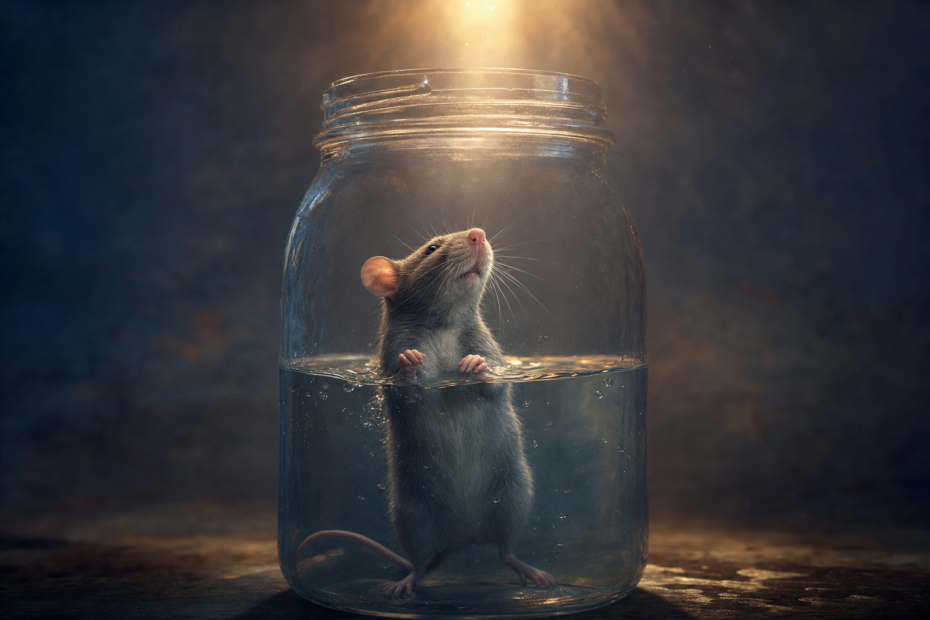
In 1957, Dr. Curt Richter — a Harvard-educated professor at Johns Hopkins — conducted an experiment that would be wildly unethical today but produced uncomfortably relevant findings. He dropped both domesticated and wild rats into jars of water to see how long they would swim before drowning.
The domesticated rats — the ones accustomed to human care — mostly swam for 40 to 60 hours. They fought like hell. A few, though, quickly assessed the smooth glass walls, the impossibility of escape, and gave up within minutes. They just… stopped. Many of the wild rats didn’t even make it into the water — they died of cardiac arrest from the sheer terror of being handled. The ones that did make it into the jars? Dead within one to fifteen minutes. No struggle. No fight. They simply accepted their fate and sank.
Here’s where it gets interesting — and where I need you to pay attention, because this is the part that matters.
Richter ran the experiment again. But this time, just as the rats began to give up, he reached in, plucked them out, toweled them off, let them rest, and then put them back in the water.
Every single group — domestic, wild, all of them — swam for 60 to 80 hours.
Not because their physical capabilities changed. Not because the water got warmer or the walls got shorter. Because they had been shown, once, that rescue was possible. That a hand might appear from above. That their situation, however desperate, was not necessarily the end.
Hope. That’s all it was. The memory of being saved, converted into the belief that being saved might happen again. And it was worth 60 to 80 hours of desperate swimming.
Who’s Doing the Plucking Now?
In Richter’s experiment, it was the scientist who reached in. In history, it was the leaders — the Medicis, the Marshalls, even the ordinary everyday people — who organized and said not yet, we’re not done yet. They stepped up to find hope. And many of them made mistakes. The point wasn’t perfection. The point was the hand reaching into the jar.
Where are those kinds of leaders now? I am sure they are out there, is just that our partisan, social-media algorithm-driven world makes them impossible to find. The current crop of “leaders” demanding our attention is selfish and corrupt.
Of course, leaders have always been selfish and corrupt to varying degrees. That’s not new. But there used to be a baseline expectation that part of the job was giving people a reason to keep swimming. FDR told a terrified nation that the only thing to fear was fear itself — and then actually built things: infrastructure, institutions, safety nets. Even during the Cold War, when the threat of nuclear annihilation was arguably more existentially dire than anything we face today, our leaders built bomb shelters, ran civil defense drills, and told us to duck and cover. Was duck-and-cover going to save you from a nuclear blast? Of course not. It was absurd. But it was a signal: we are trying. We have not given up on you. There is a plan, even if the plan is mostly theater.
That theater mattered. It was the hand reaching into the jar.
Now look at where we are. In 2008, a presidential candidate ran on a single word: Hope. Whatever you think of him or his policy record, his aspiration for hope was clear, and it resonated with millions. People lined up for hours to vote for the idea that the future could be better.
Fast forward to today. The current president’s entire rhetorical framework is built on the opposite premise: everything is broken, the country is a disaster, the world is laughing at you, and only one man — one singular, irreplaceable man — can fix it. That’s not hope. That’s a hostage negotiation. It’s a message designed not to inspire swimming but to make you grateful someone is holding your head above water — while conveniently ignoring that he’s also the one pushing it under.
And it’s not just one leader. Across the political spectrum, across the globe, the dominant mode of leadership has shifted from “here’s where we’re going” to “here’s who to blame.” We’ve replaced vision with grievance. In the U.S, our leaders can’t even agree on basic measures to reduce gun violence in schools — even a clear majority of voters wants them to do something. Our leaders won’t even perform the theater of trying anymore.
No hand is reaching in. And the rats are noticing.
The Accumulation Problem
It’s not any single problem that has exhausted hope. It’s the accumulation.
Climate change alone might be manageable. Political polarization alone might be survivable. The erosion of institutional trust, the loneliness epidemic, the housing crisis, the healthcare catastrophe, the rise of authoritarianism, the AI disruption, the gun violence, the opioid crisis, the microplastics pollution, the continued loss of pollinators, the student debt trap, the slow death of local journalism, the algorithmic radicalization of the disillusioned — any one of these, in isolation, is a problem a healthy society could theoretically address.
But we’re not facing them in isolation. We’re facing all of them simultaneously, while our institutions are weakened and our leaders are either absent, incompetent, or actively making things worse. It’s not one disease. It’s comorbidity. Each condition worsens the others. And the cumulative effect is a kind of civilizational exhaustion that makes even the optimists grab the tequila bottle and stare into space.
Our kids aren’t reconsidering children because of climate change or because of politics or because of economics. It’s because of the weight of everything, everywhere, all at once. Because when you add it up, the sum looks less like a problem to be solved and more like a verdict to be accepted.
And when a generation looks at the future and decides it’s not worth populating — well, that’s not a demographic trend. That’s a species-level loss of hope.
The Dual Reading of “Exhausted Hope” So Which Is It?
I promised you two readings of this post’s title, Perhaps We Have Exhausted Hope. Here are the two that continually tax my mind.
“Perhaps we have exhausted hope” could mean there is a finite and we’re scraping the bottom. The universe allotted us a certain amount of optimism, and we’ve spent it on wars and recoveries and moonshots and civil rights movements, and now the account is overdrawn. If this reading is correct, we’re in genuine trouble. You can’t manufacture a resource that’s been depleted. All you can do is watch the gauge drop.
“Perhaps we have exhausted hope” could mean that the entity known as hope is simply tired and needs time to recover. It is beaten down by the sheer volume of things working against it, but not dead. Just in desperate need of rest, of care, of someone to pluck it out of the jar and towel it off and give it a reason to believe that rescue is still possible. If this reading is correct, then recovery is at least theoretically possible — but it requires something we’re critically short on: leaders willing to do the plucking.
I want to believe the second reading. Badly. But I can’t ignore the evidence for the first.
So Where Do We Go From Here?
I think a lot about my kids. I think about the wild rats — the ones who’d never been rescued, who had no framework for believing rescue was possible, and who simply sank without a fight. I think about a generation deciding the future isn’t worth inhabiting. And I think: is this what the early stages of giving up look like? Not with a bang, not with a whimper, but with a quiet, rational decision not to bring children into the world?
Hope has been exhausted before. Many times. And every time, some stubborn, irrational, beautiful fool decided to reach into the jar anyway. It may be the neighbor who organizes a school board meeting, the teacher who stays late, the kid who registers voters, the friend who calls to check on you when the news is especially dark. Sometimes the hand that pulls you out of the water belongs to someone who’s barely swimming themselves.
We may have exhausted hope. But hope has been exhausted before, and it has this stubborn, infuriating habit of refusing to stay dead.
Whether that’s enough — I honestly don’t know. But I’m still swimming. And if you’re reading this, so are you.
That’s not nothing.
Get the best of Sevenelles in your inbox. Free, no ads, one click to leave.
Subscribe