
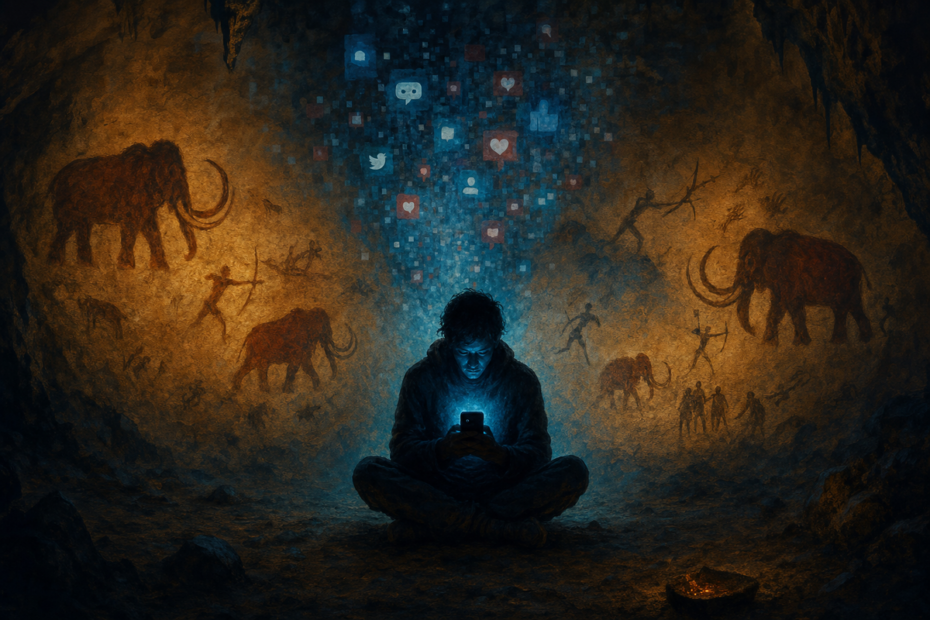
Somewhere around 2006, we started asking a three-pound lump of neurons — built to track the roughly 150 familiar humans in our tribe — to instead wake up on digital command, absorb the emotional weight of a genocide on the oterh side of the globe, compare our net happiness to the vacation pictures posted by our 100s of “friends”, and then struggle to produce a chipper Facebook update proving said happiness. And we do this – and SO much more – all before we get to enjoy our first good bowel movement of the day. And we have been doing this voluntarily. Every day. For decades.
Can we all take a second to step back and admit that this is really not good? No wonder we are not okay.
The scientists have officially diagnosed us
A recent review in Behavioral Sciences, summarized nicely by ZME Science, uses a phrase that should be printed on the back of every smartphone: evolutionary mismatch. The idea is that our brains evolved for one world, and we now live in a completely different one, and the gap between those two worlds is where all our anxiety, loneliness, doomscrolling, and low-grade nihilism come from.
We already know the food version of this. Sugar and fat were once rare and precious, so we evolved to hoover them up whenever we could. Now they’re piped into gas stations at 3 a.m. in the form of blue Icees the size of a toddler, and we’re shocked that half the country has metabolic syndrome. Same Pleistocene + 24/7 food glut = Diabetes and the explosion of GLP-1 use.
The scientists now recognize that the social version of this mismatch is doing to our minds what the Big Gulp did to our pancreases (pancrei?).
We were built for a village. Instead we have a news feed.
Our ancestors lived in bands of maybe 50 to 150 people. You knew everyone in your tribe. They knew you. If you screwed up, Grog gave you the stink-eye across the fire, you apologized by sharing your haunch of mammoth, and life continued.
Now your brain — using that same Pleistocene hardware — is trying to rank you against every influencer, ex-classmate, tech billionaire, and pilates-toned stranger an algorithm shoves in your face. Your status-detection module was designed to handle a village. You’re trying to handle the entire planet – a planet that also seems to be on fire, figuratively and literally.
This isn’t just cranky-old-man theorizing. A 2025 study in Nature Human Behaviour found that adolescents with mental health conditions were significantly more sensitive to online social comparison and feedback than their peers. Translation: the kids most vulnerable to comparison are the ones being served the most of it, at maximum brightness, at 1 a.m., in bed. What could possibly go sideways?
Loneliness has become a WHO-level emergency
The World Health Organization now considers loneliness a global health threat, estimating it affects roughly one in six people worldwide and increases risk of stroke, heart disease, dementia and early death at rates comparable to smoking. Let that land for a second: our species — the one that literally cannot survive infancy without other humans — is now dying from a shortage of them.
The former U.S. Surgeon General wrote an entire advisory comparing the health impact of chronic loneliness to smoking 15 cigarettes a day. Fifteen. And unlike cigarettes, you don’t get to enjoy the enveloping warmth of the first nicotine hit.
Meanwhile, Pew reports that nearly half of American teenagers are online “almost constantly.” Not a lot. Not frequently. Almost constantly. A generation is being raised inside a slot machine regularly insults their appearance.
The Greatest Hits of ways we’re breaking ourselves
A partial inventory of ancient brain vs. modern environment:
- Threat-detection system designed for saber-toothed cats, now processing 47 push notifications about civil unrest in a country you cannot pronounce.
- Mate-selection instincts tuned for the six eligible humans in your village, now sorting through 4,000 curated faces on Hinge, each optimized with a filter that makes them look like an anime sex god.
- In-group loyalty circuits designed for actual tribes, now hijacked by cable news to make you hate your neighbor because of a bumper sticker.
- Reciprocity systems that once tracked “Did Grog share the berries?” now trying to compute whether an influencer with 4 million followers is really your friend.
- Attention span, formerly capable of tracking an animal for six hours, now unable to finish a paragraph without checking whether anyone liked the paragraph you just posted.
Jonathan Haidt has been screaming about this for years, mostly about kids and phones, and increasingly the data is doing the screaming with him. Depression, anxiety and self-harm among adolescents began climbing in a suspiciously vertical line starting around 2012 — right when the smartphone became universal, and the front-facing camera taught every 12-year-old to audit her own face for a living.
Some people are quietly walking out of the casino
Here’s the interesting part. A small but growing number of humans have started noticing the fluorescent lights, the free drinks and the missing windows, and are simply… leaving the casino.
Teenagers, of all people, are leading the charge. The New Yorker has documented a real, if small, trend of Gen Z kids trading their iPhones for “dumbphones” — flip phones, Light Phones, the kind of brick your dad had in 1998. The stated reason is almost tender: they want to feel like people again.
Parents are organizing Wait Until 8th pacts, collectively agreeing to keep smartphones out of kids’ hands until at least eighth grade so no single family has to be the weird one. Whole schools and, in some cases, whole countries are banning phones from classrooms — and the early data is showing exactly what you’d expect: better grades, less bullying, more talking to actual humans.
Meanwhile, adults are rediscovering things called “clubs” and “third places” — running clubs, book clubs, church basements, board-game nights, even the ancient technology of having people over for dinner. Somewhere a sociologist is crying with joy that some people are reinventing the neighborhood.
A modest, panicked plea
Look, I’m not going to pretend I’m out here churning butter and organizing a barn raising. I’m typing this into a device that will beam it into a network that will notify a machine that will decide whether other machines should show it to you. I’m as compromised as anyone. The call is coming from inside the house, and the house is on fire, and the fire is also a phone.
But here’s the thing. Every one of us gets exactly one Pleistocene brain, non-transferable, no refunds. And right now we are handing that irreplaceable piece of hardware to whichever billionaire has the shiniest app and saying, “Do whatever you want with this, I trust you.”
So maybe — just as a thought experiment — put the phone in a drawer for an evening. Or actually use the phone part of your smartphone to call somebody and have a conversation. Invite three humans over and feed them something you burned yourself. Go for a walk without documenting it. Meet a neighbor whose politics you’ll hate and discover they’re weirdly nice in person. Read a whole book. Get bored. It turns out boredom is key to success and happiness.
Because if we don’t start clawing back some of the wiring we came factory-installed with, the endgame here isn’t pretty. It will be us, in about forty years, sitting in climate-controlled pods, being emotionally regulated by an AI that pats our heads and calls us “good human” every time we finish our nutrient paste. Like a tiny, inbred lapdog. Cue the music:

Get the best of Sevenelles in your inbox. Free, no ads, one click to leave.
Subscribe