
Smart Ass Take:
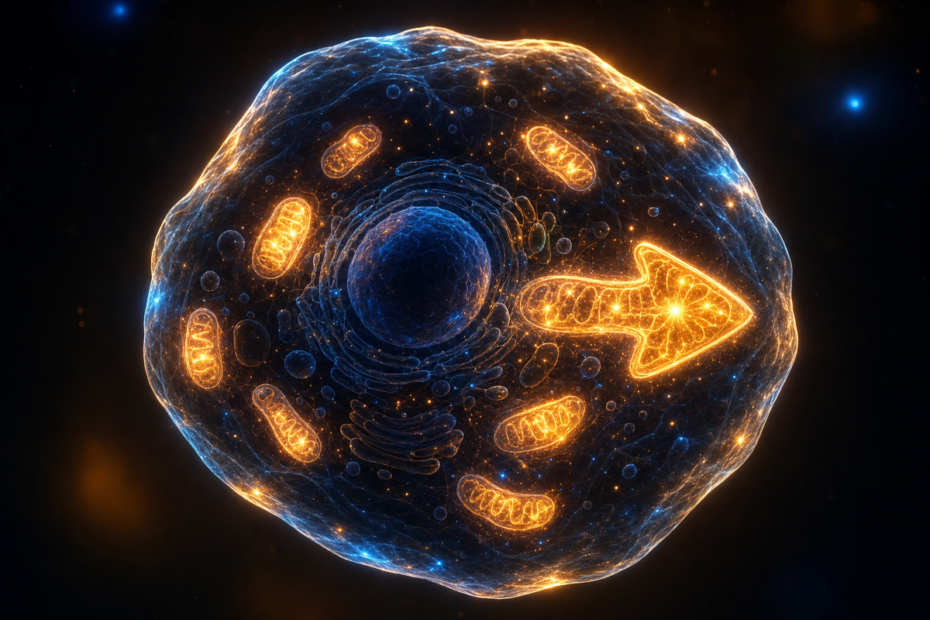
Turns out your mitochondria have been reading your diary. Curt Buermeyer (writing from inside a 132-degree sauna, as one does) points to Dr. Martin Picard’s research showing that chronic stress burns roughly 60% of your daily cellular energy just keeping the lights on — and that people with a genuine sense of purpose have measurably stronger mitochondria. Purpose, it seems, is not a TED Talk abstraction. It’s fuel. The drift you feel on a Tuesday afternoon isn’t laziness or a character flaw; it’s your cells running a maintenance loop because you haven’t given them anywhere interesting to point. Which lands squarely in LIVE and LABOR territory, with LEGACY watching from the doorway. The uncomfortable question isn’t the big one — why are you here, cosmically, etc. It’s the small one: how many hours today did you spend genuinely aimed at something versus just being conveyed through them? Your cells apparently already know the answer.
Article Excerpt:
When you’re under chronic stress, the basic energy cost of just keeping your cells alive jumps by roughly 60%. Not the energy you use to think or move or create — just the energy required to maintain baseline cellular function.
Article Summary:
Curt Buermeyer opens sweating through a sauna session at 132 degrees, discovering that his brain had been quietly demoted while his body dealt with not cooking itself. That got him thinking about cellular energy — specifically the work of Dr. Martin Picard at Columbia, who runs the excellently named Mitochondrial Psychobiology Group and picked up a $1.5 million science prize in 2024 for treating mitochondria as information processors rather than the dusty “powerhouses” of high school biology.
The headline finding: chronic stress raises the baseline energy cost of simply keeping your cells alive by about 60%. Meaning more than half of what you’ve got is spent treading water before you do anything useful with it. Healing, learning, creating — all downstream of whatever’s left after the stress tax.
The really intriguing (and perhaps pseudo-scientific) part: Picard’s 2024 research shows that people with a strong sense of purpose have measurably more powerful mitochondria. Purpose is not just a motivational-poster concept — it’s a biological input your cells respond to.
Read the Full Article
Get the best of Sevenelles in your inbox. Free, no ads, one click to leave.
Subscribe